Your Custom Text Here
Welcome to WOOD.LAND., Tyler Moorehead, 2021
Portraits and soundscapes from the urban woods pre-imagine a warm, woodland welcome not always extended to those from marginalised groups.
Welcome to WOOD. LAND. aims to gain access to deeper research on the emotional and social connections between ethnicity and nature, and the environmental implications of exclusion.
Drawing on forest ritual and oral traditions, Welcome to WOOD.LAND. creates conversations in nature to build capacity to challenge and re-negotiate ‘urban’ narratives, which often do not include green space.
In the woods, we bear witness to our collective experience of disenfranchisement in nature. Walking together, we welcome ourselves, and inhabit the urban woods on new terms.
Natural soprano and bass tones from bird calls, rustllng trees, scrambling squirrels, beats on hollow logs, runners on gravel, dogs in puddles, and planes rumbling overhead.
Field recordings from Highgate Wood and Queens Wood North London.
Birds, squirrels, woodland sounds and percussion of woodland runners accompany Debi Tinsley's (www.debitinsley.com) vocal performance of a deconstruction of Maya Angelou's epic poem 'When Great Trees Fall'.
Portrait of wood walker in ‘protective’ red sculpted leather cape with orange grosgrain ribbon tie.
Intimate armour ‘fittings’ to open conversation formed part of the methodology for portraits and relational research.
Portrait of participants in organza masks
Protective cape from sculpted and fired leather offcuts is lined with vintage Japanese brocade.
Portraits of wood walkers in protective armour
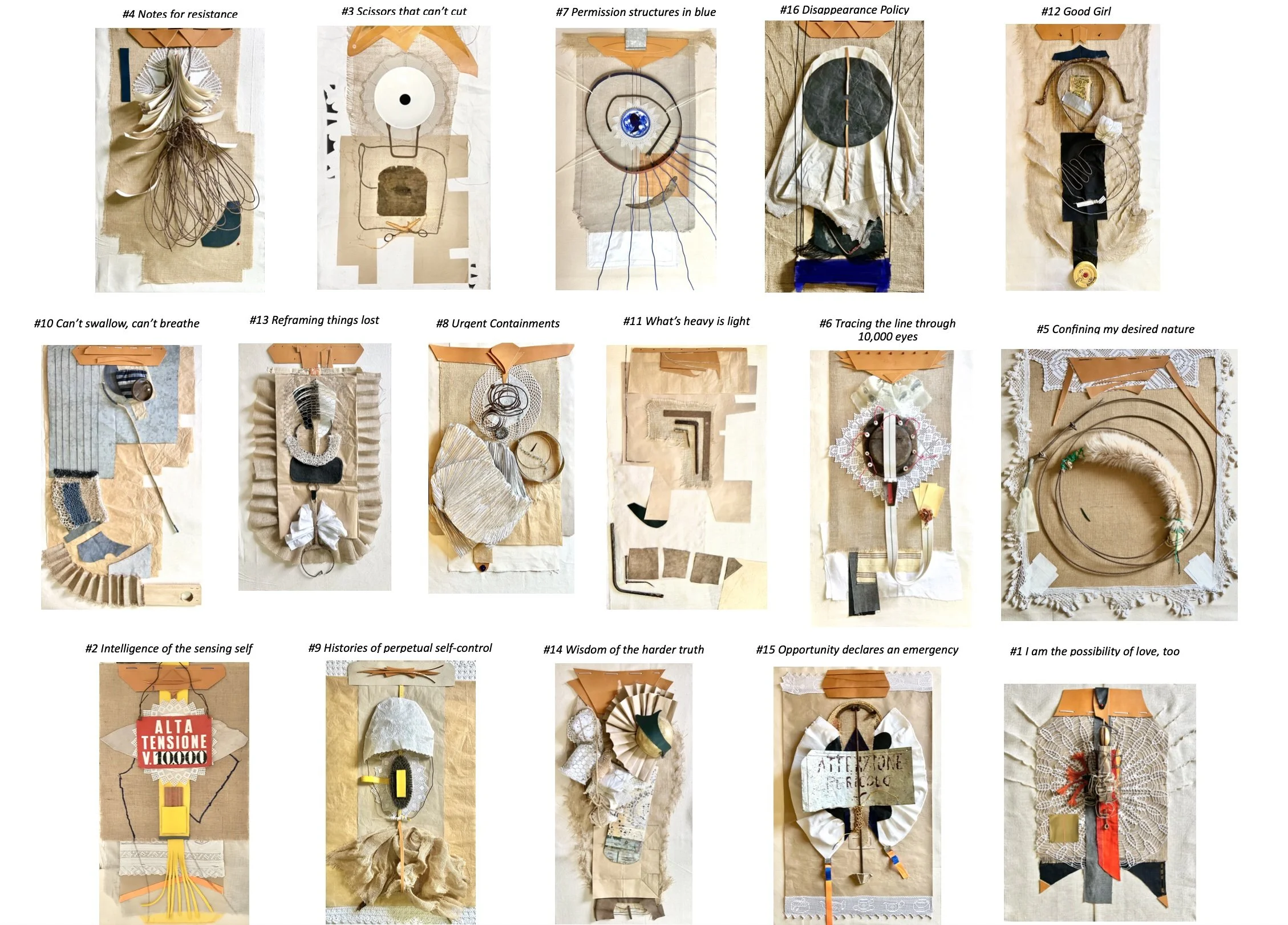
16 x Self-Portrait diary entries as evidence base.
DYSTROPIUM is a term of the artist’s invention - a portmanteau of dystopia, dysphoria, delirium, trope, distraction, destruction and even hope.
Diary pieces were produced as evidence to embodied emotions in response to television, podcast, blog and news reports concerning US politics during the historical 4 month period from US Inauguration Day 20 January, through 20 May, 2025.
Using assemblage, collage, found objects and materials, the artist undertakes an accounting of ephemeral data, as record keeping of emotional responses.
Each diary entry depicts forms of frustration, impotence, internalisation or unexpressed rage born from habits of polite dissent and self-repression. Titles relate to embodied emotions experienced and observed. Each ‘entry’ is ‘drawn’ with objects, textiles and materials to hand in direct response to specific issues or events taking place during this period.
This iteration of the work explores a social legacy of self-restraint, self-control and euphemistic decoration that demanded decorum and mastery of the art of polite dissent. It considers the costs versus the value of an inheritance of ‘respectability politics’. Masking emotions designed to keep ‘unpleasantness’ at bay.
The Diaries form part of an installation-in-development for a walkthrough DYSTROPIUM, where visitors will be able to playfully confront their own feelings of disempowerment and use objects to express what they feel.
New forms of knowledge and research
Looking to the role of art in society as a connector and resource, the artist seeks to build on previous research to validate new forms of data gathering and analysis, and to lend rigour to non-traditional forms of information.
Using emotion as a stream of information, the compositions aim to bring together ancient ways of knowing, with modern methods of scoping, collecting and articulating data.
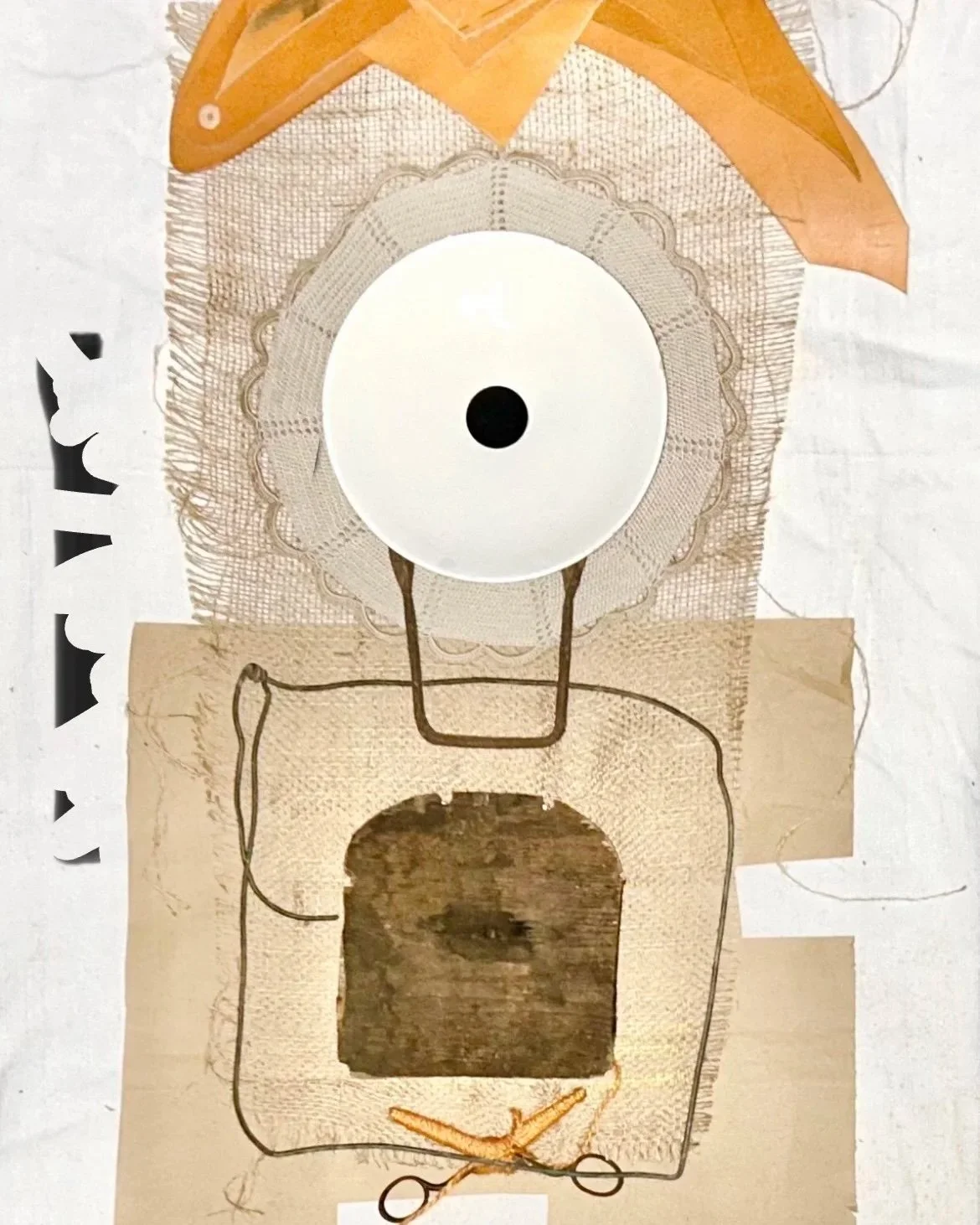
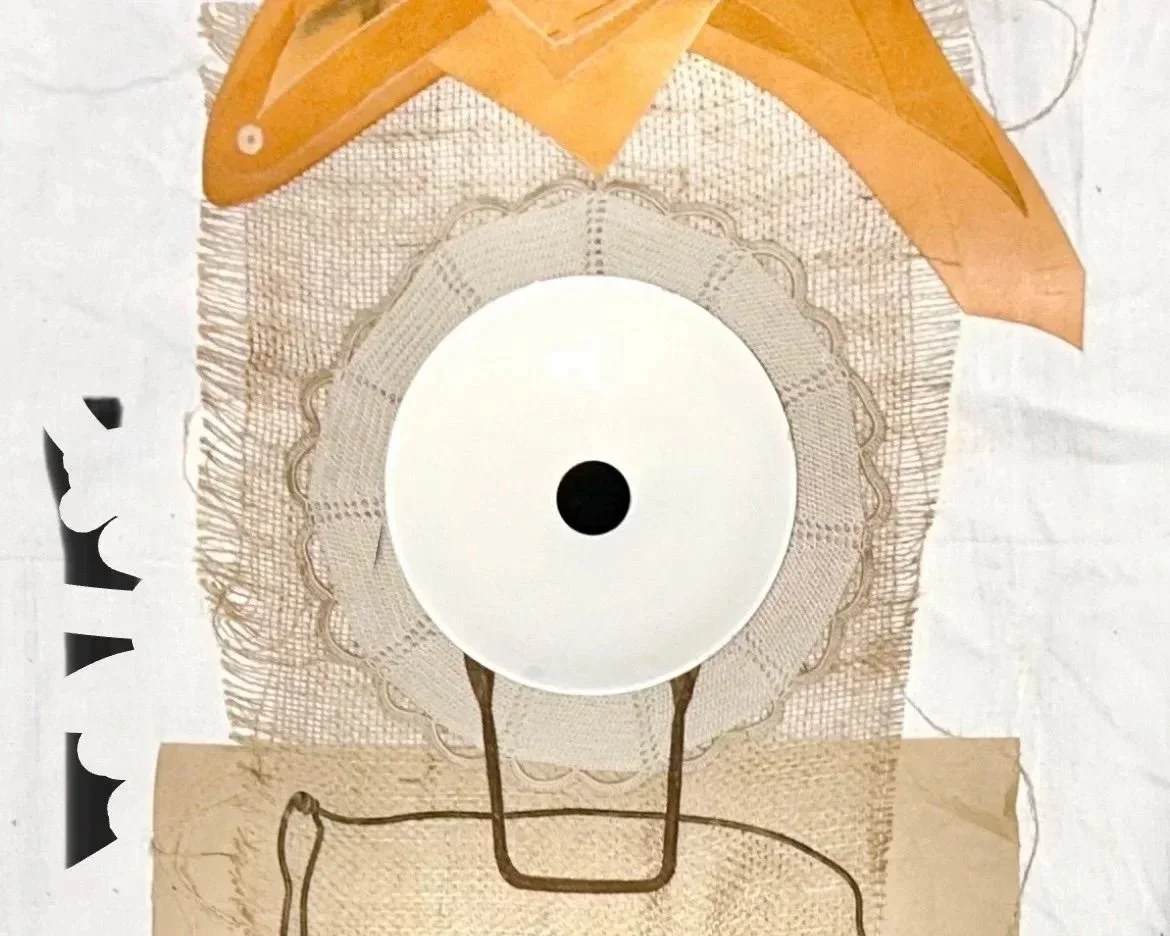
DYSTROPIUM #7 Scissors that don’t cut
57cm x 115cm. Leather, hessian, wood and paper offcuts, vintage wire, doily and lightshade, acrylic paint on canvas and wood.
DYSTROPIUM #10 Can’t Swallow, Can’t Breathe
66cm x 115cm, galvanised steel offcut, leather remnants, cut paper, hessian, knitted cord insert, found objects on canvas and wood.
DYSTROPIUM #4 Notes for resistance, 2025
65cm x 115cm, Hessian, leather offcuts, lace doily, cut paper, found objects with wire sculpture on canvas and wood.
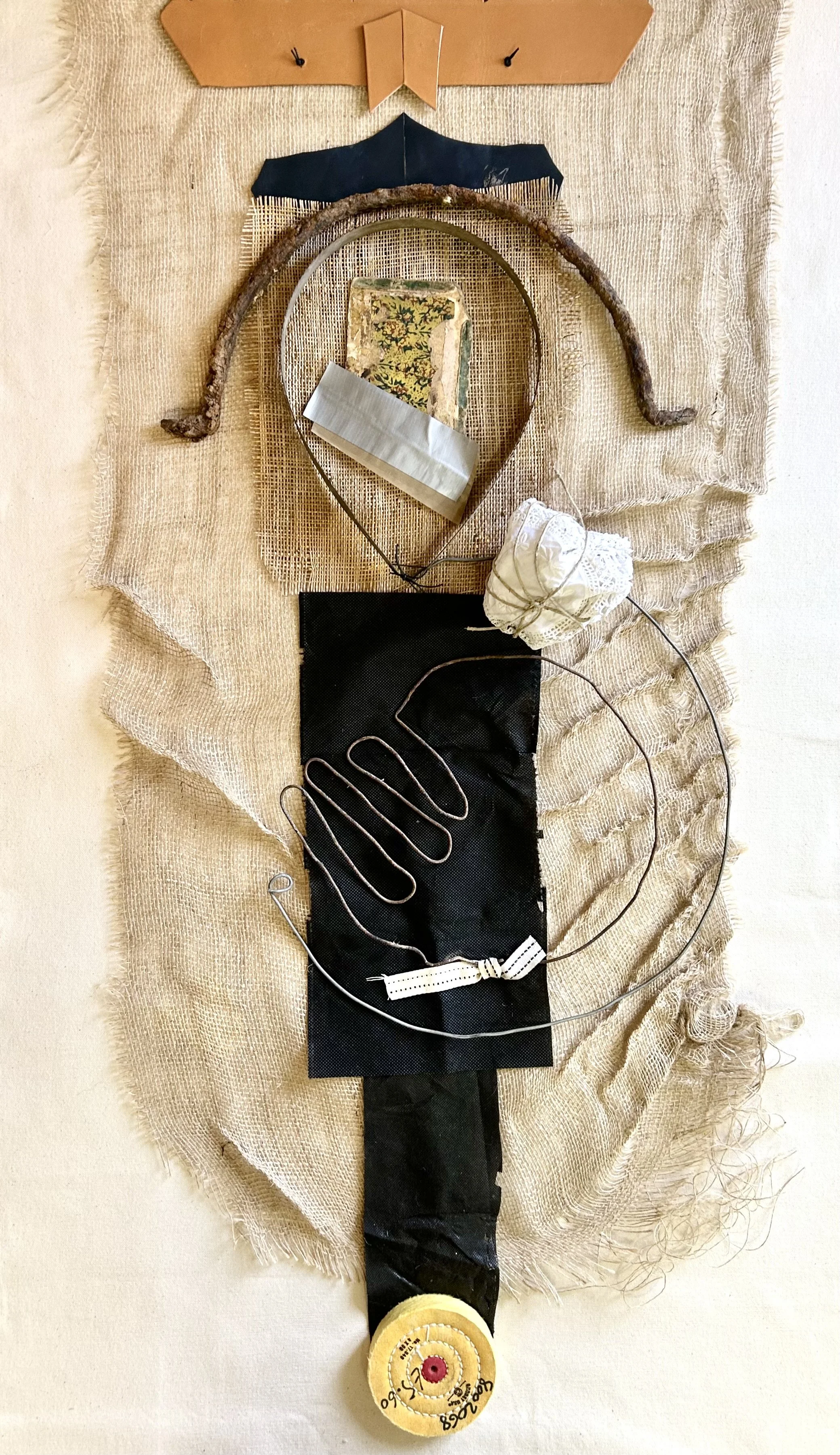
DYSTROPIUM #12 Good Girl, 2025
65cm x 115cm, Pintucked hessian offcut, leather remnants, lace doilies, sculpted vintage wire, found objects on canvas and wood.
Body of evidence. DYSTROPIUM DIAIRIES. 16 expressions of emotional data.
Ocean Drifters, Tyler Moorehead & Lucy Papadopoulos, 2019 - 2022.
Ocean Drifters is a live sound experience that uses sonic composition, real-time sound capture and embodied learning to stimulate human empathy with life at a microscopic scale.
Inspired by indigenous philosophy, Ocean Drifters is a provocation and a collective meditation that aims to place empathy at the centre of ecology, and reconnect us to the waters from which we emerged and still need to survive.
Ocean Drifters aims to use the transcendence of felt experience to rekindle human relationship to underwater primordial life.
Tens of thousands of marine creatures drift our ocean waves to feed and to breed. Many of these are the microscopic plankton that make up 90% of all marine life, and which form the foundation of our ecosystem.
Sonic submersion invites participants to temporarily recapture their place within the infinite ambiguity of the ancient ocean.
Ocean Drifters opens a speculative enquiry into the serious question of human impacts on marine organisms’ ocean drifting way of life. The soundscape accompanies abstract marinescapes and uses an array of analog and digital sounds, including the sound of air guns and found materials in the sea, to convey the distortion of sound in ocean water.
As part of this speculation, the reflective phase of Ocean Drifters asks visitors to respect intuitive forms of knowledge, trusting their own experience of physical vibration and sound as one valid form of understanding.
Showcased at IRCAM, Paris, 2020 and included in ‘Design in an age of crisis’ selection at London Design Biennale 2021 .
AUDIO: Listen to an Ocean Drifters Sample soundscape.
Ocean Drifters is designed to help visitors connect to other species as kindred spirits, in order to stand in a more humble space as fellow earth citizens and guardians.